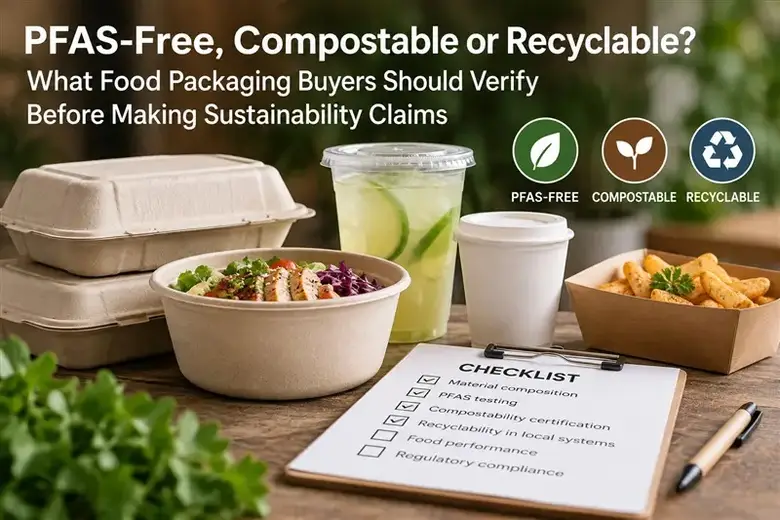
Food packaging has acquired a crowded environmental vocabulary.
A fiber bowl may be sold as PFAS-free. A clear cold cup may be compostable. A coated paper container may be described as recyclable. Other packs carry terms such as plant-based, biodegradable, or plastic-free.
Those claims may all be legitimate. The problem is that they answer different questions.
For buyers, that distinction matters.
A sustainability claim should not be treated as a general badge of environmental performance. It should be treated as a statement that needs a clear definition, a technical basis and, where appropriate, supporting documentation.
That sounds obvious. In practice, it is still one of the areas where food packaging procurement gets surprisingly complicated.
The first mistake is grouping different claims together
PFAS-free, recyclable, and compostable are often discussed in the same conversation, even though they describe very different characteristics.
PFAS-free is mainly about chemical composition or restriction.
Compostability is about how a product behaves under defined composting conditions.
Recyclability concerns whether the material can enter a suitable recovery system.
Bio-based tells us something about feedstock origin.
Plastic-free tells us something about composition, although the exact boundary still needs to be defined.
One claim does not automatically imply another.
A molded-fiber container can be PFAS-free without being certified compostable. A compostable cup may still be discarded as general waste if no suitable collection system exists. A paper package may be technically recyclable but rejected by a local facility because of its coating or construction.
That is why buyers should avoid broad specifications such as “must be sustainable” or “must be eco-friendly.”
They are difficult to verify and even harder to compare between suppliers.
PFAS-free: ask what the supplier actually means
PFAS has become a major issue in food-contact packaging because fluorinated chemistry has historically been used in some applications to improve resistance to grease, oil and moisture.
The move away from PFAS is now well established, particularly in molded fiber and paper-based foodservice packaging.
But the wording matters.
There is a difference between saying:
- PFAS is not intentionally added;
- a supplier has issued a declaration;
- a product has been screened for total fluorine; or
- a finished package has been tested against a defined regulatory limit.
Those statements should not be treated as equivalent.
This has become more important under the EU Packaging and Packaging Waste Regulation. From August 12, 2026, food-contact packaging placed on the EU market is subject to specific PFAS concentration limits: 25 ppb for any targeted PFAS, 250 ppb for the sum of targeted PFAS, and 50 ppm for PFAS including polymeric PFAS under the conditions set by the regulation.
The exact requirements are set out in the European Union’s official Packaging and Packaging Waste Regulation (EU) 2025/40.
For procurement teams, the useful question is therefore not simply:
“Is it PFAS-free?”
A better question is:
“How is PFAS-free being defined for this product, and what evidence supports that definition?”
That usually produces a much more useful answer.
Removing PFAS does not tell you what replaced it
This is particularly important with fiber packaging.
If fluorinated grease-resistant chemistry has been removed, something else may still be needed to give a paper bowl or molded-fiber tray the required resistance to oil, sauces or moisture.
That may be a water-based dispersion barrier, another coating system or a polymer layer.
So a PFAS-free claim tells a buyer only part of the story.
It does not automatically mean plastic-free, compostable, recyclable or suitable for every waste stream.
The barrier system still needs to be understood.
This is one reason why specifications based only on the base material can be misleading. Two containers that both appear to be “fiber packaging” may have very different constructions and very different end-of-life implications.
For buyers comparing molded fiber and bagasse food packaging, it is worth looking beyond the visible fiber substrate and asking what barrier system is actually being used.
A sugarcane-fiber tray designed for dry bakery products, for example, does not face the same demands as a container expected to hold hot curry, oily noodles or sauce-heavy meals for an extended delivery period. The fiber may look similar; the technical requirements are not.
Compostable is only useful when the conditions are clear
The word “compostable” also needs context.
Industrial composting and home composting are not the same thing. A certification for one does not automatically apply to the other.
There is another issue that buyers sometimes miss: whether the claim applies to the finished package or only to one material used in it.
Real food packaging may include fiber, coatings, inks, adhesives, labels, lids, and other components. A compostability claim should reflect the actual configuration being purchased, not simply the properties of one raw material.
That distinction matters.
A resin may be compostable. A coating may have its own test data. But the finished cup, bowl, or container still has to be considered as a complete packaging system.
There is also the question of infrastructure.
A product can be genuinely certified for industrial composting and still end up in landfill or incineration if there is no suitable collection route where it is used.
That does not make the certification invalid.
It does mean the environmental outcome is different from what many buyers assume when they see the word “compostable.”
The U.S. Federal Trade Commission makes a similar distinction in its Environmental Claims: Summary of the Green Guides. The guidance states that compostable claims need competent and reliable scientific evidence and may require qualification when suitable composting facilities are not widely available.
For buyers operating across several markets, that last point is easy to overlook. A packaging specification that makes sense for a closed-loop event venue with access to commercial composting may make much less sense for a takeaway chain operating in areas without organic-waste collection.
Certification and infrastructure answer different questions
This is probably one of the most useful distinctions in sustainable packaging.
Certification answers a technical question:
Can the product meet defined requirements under specified conditions?
Waste infrastructure answers an operational one:
Will the product actually reach those conditions after use?
Those are not the same question.
The same issue appears with recyclable packaging.
A material may be technically recyclable, but actual recovery depends on what happens after disposal: collection, sorting, contamination, coatings, local recycler acceptance and whether there is enough economic value in the recovered material.
For that reason, “recyclable” should not be treated as a purely material-level property.
The system around the packaging matters just as much.
Food packaging makes recyclability harder than it looks
Food packaging has to perform before it can be recovered.
A soup bowl has to hold hot liquid.
A takeaway container has to survive oil, sauce and delivery.
A paper cup has to remain rigid while holding a beverage.
A bakery pack may need grease resistance.
Those requirements often introduce coatings, liners, adhesives or combinations of materials that complicate recycling.
The presence of paper on the outside does not automatically make the package straightforward to recycle.
A better procurement question is:
Which waste stream is this pack designed to enter, and is that stream actually available in the markets where it will be used?
That question is less convenient than putting a recycling symbol on the artwork, but it is much closer to the real issue.
The U.S. Environmental Protection Agency’s Recycling Basics and Benefits also treats recycling as a system involving collection, processing, and manufacturing rather than simply a characteristic printed on a package.
For foodservice packaging, contamination adds another practical layer. A theoretically recoverable material may still perform poorly in the real recycling stream if it commonly arrives with food residue, liquid or materials that local facilities are not set up to separate.
“Biodegradable” is usually too vague on its own
Biodegradable is another term that can create more confusion than clarity.
The obvious follow-up questions are:
Under what conditions?
At what temperature?
Over what period?
In soil, industrial compost, freshwater, marine conditions or somewhere else?
A material that breaks down under controlled composting conditions should not automatically be assumed to behave in the same way in landfill, open soil, or the marine environment.
For professional buyers, a specific statement such as:
“Certified for industrial composting under a defined standard”
is usually far more useful than:
“Biodegradable packaging.”
Specific claims are easier to verify and harder to misunderstand.
A certificate is part of the evidence, not the whole file
There is also a tendency to ask for “the certificate” as if one document can settle every question.
It cannot.
Different claims require different evidence.
A serious packaging file may include the material specification, food-contact documentation, PFAS-related test data, compostability certificates, barrier information, and performance testing.
The important point is consistency.
If the website says one thing, the specification says another and the certificate applies only to a raw material rather than the finished item, the buyer still has work to do.
This is where good procurement is less about collecting documents and more about checking whether the documents describe the same product.
For buyers dealing specifically with fluorine restrictions, Bioleader’s technical guide to PFAS-free packaging compliance and verification provides a more detailed look at supplier declarations, total-fluorine screening, targeted PFAS analysis and the current EU PPWR thresholds.
The distinction matters because a laboratory report containing the words “fluorine” or “PFAS” is not automatically proof of every PFAS-related claim. Buyers still need to know what was tested, which analytical method was used, what detection limit applied and whether the tested sample matches the product actually being ordered.
Performance still comes first
There is little environmental benefit in a package that fails during use.
A compostable bowl that leaks after ten minutes with hot food is not a successful solution.
Neither is a recyclable cup that loses rigidity, or a PFAS-free tray that cannot hold oily food for the required service period.
Any material change should therefore be tested under real conditions.
That may include hot food, oil, sauces, condensation, refrigeration, microwave use where relevant, stacking, transport and lid fit.
This becomes especially important when changing barrier systems.
Two molded-fiber containers can look almost identical and still behave very differently because of formulation, coating, forming process or intended application.
Review sustainability and functional requirements together, not in separate parts of the specification.
Seven questions worth asking before approving a claim
Before a sustainability claim is accepted for a tender, catalog or packaging artwork, buyers should be able to answer seven basic questions:
- What exactly is being claimed?
PFAS-free, recyclable, compostable, bio-based and plastic-free are different claims. - Does the claim apply to the complete finished pack?
Check coatings, lids, inks, adhesives, and other components. - What evidence supports it?
A declaration, certificate, specification, and test report do not all prove the same thing. - Which standard, regulation or test method is being referenced?
- Does the evidence apply to the exact product being purchased?
- Is the intended end-of-life route available in the target market?
- Has the product been tested under actual foodservice conditions?
If those questions cannot be answered clearly, the claim probably needs more work.
Better specifications are more useful than better adjectives
The next stage of sustainable packaging procurement is unlikely to be driven by adding more environmental language to product descriptions.
It will be driven by narrower claims and better evidence.
“Eco-friendly” tells a buyer almost nothing.
By contrast, a specification that says a product has been tested against a defined PFAS threshold, is certified for a stated composting route, is suitable for a particular food temperature and is supported by current food-contact documentation gives procurement teams something they can evaluate.
The same principle applies whether the packaging is made from molded fiber, paper, PLA, another biopolymer or conventional plastic.
Suppliers can help by making claims more precise.
Buyers can help by asking for evidence before those claims reach menus, tender documents, packaging artwork or consumer marketing.
The strongest sustainability claim is rarely the broadest one.
It is the one that can survive the next question.