Beauty packaging used to be judged mainly by three things: how it looked on the shelf, whether it protected the formula, and how much it cost.
That is no longer enough.
As brands prepare product launches for 2027, packaging teams are being pulled in several directions at once. A pack still has to feel desirable, but it also needs to survive e-commerce, work with increasingly sophisticated formulas, meet tightening recycling requirements, and support sustainability claims that can stand up to scrutiny.
The signals were already visible throughout 2026. BeautyMatter has similarly highlighted mono-material components, smart packaging, lightweight luxury and more deliberate sustainability strategies as forces reshaping beauty packaging.
What is changing, then, is not simply the appearance of cosmetic packaging. It is the way brands think about the entire system around the bottle, jar, pump or dropper.
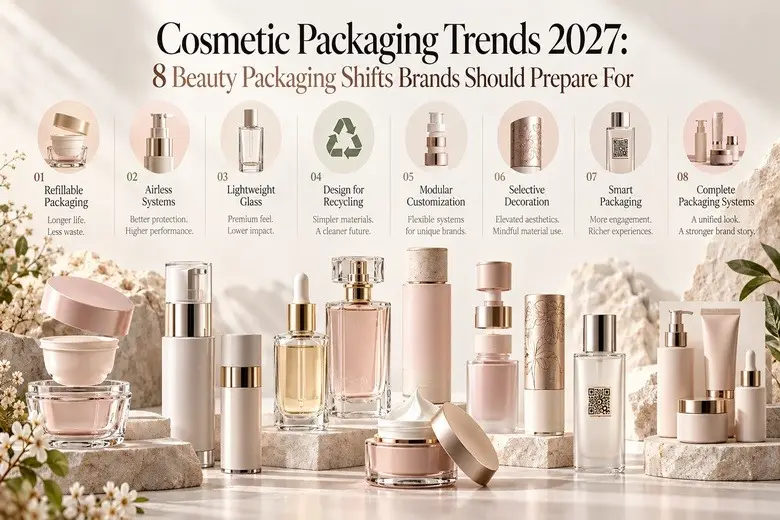
Here are eight shifts likely to matter most as the industry moves into 2027.
1. Refillable packaging moves beyond the showcase piece
Refillable packaging has spent years appearing in concept collections, luxury launches and sustainability presentations. The more important development now is that refill formats are starting to look less experimental.
Refillability appeared across fragrance, skincare and makeup rather than being confined to one category. Premium Beauty News’ review of the show identified refill systems as one of the major directions in high-end packaging.
The challenge for 2027 will be less about proving that a refill can be engineered and more about whether people actually want to use it repeatedly.
A beautiful outer bottle does not make a successful refill system if the cartridge is awkward to remove, the neck becomes messy, or customers need instructions every time they replace it.
The strongest refill designs are likely to become simpler.
A durable outer pack can carry most of the brand value, while the replacement component becomes lighter and easier to handle. That can work particularly well in fragrance, creams, premium skincare and some airless systems.
For brands, however, refillability should be tested as a user experience rather than treated purely as a material-saving exercise.
Can the refill be changed without spilling product? Does the closure still feel secure after repeated cycles? Is the replacement pack genuinely lower in material use? Can consumers immediately understand which part is retained and which part is replaced?
Those details will determine whether refill becomes normal purchasing behavior or remains a packaging feature that looks better in a sustainability report than in a bathroom.
2. Airless packaging becomes more closely tied to formula strategy
Airless packaging is not new, but its role in skincare is changing.
The continued growth of serums, retinol products, peptides, vitamin C formulations and higher-value treatment products has made dispensing performance more important.
A pump is no longer selected simply because a brand prefers the way it looks.
The package may need to reduce unnecessary air exposure, deliver a controlled dose, evacuate viscous product effectively, or prevent consumers from repeatedly opening the primary container.
This is one reason airless systems are receiving renewed attention.
BeautyMatter’s 2026 beauty packaging trends also point to development in mono-material pumps and airless systems as brands look for better recyclability without giving up dispensing performance.
That creates an interesting engineering problem.
Traditional pumps can contain multiple plastics, springs, and other components. Simplifying the construction can improve recyclability, but the system still has to prime correctly, return consistently,y and remain compatible with the formula.
For 2027 launches, the better starting question may therefore be:
Does this formula genuinely benefit from airless packaging?
If the answer is yes, dispensing performance and compatibility should lead the selection process. Sustainability and aesthetics then have to work around those functional requirements.
Airless should not become another label automatically added to premium skincare.
It should solve a real formulation or dispensing problem.
3. Glass remains premium, but unnecessary weight becomes harder to defend
Glass remains deeply embedded in prestige beauty.
Serum bottles, fragrance, facial oils, creams and treatment products still benefit from the material’s clarity, feel and perceived permanence. Few packaging materials communicate premium positioning as easily as a well-designed glass bottle.
But the old formula of making a bottle heavier simply to make it feel more expensive is beginning to look dated.
BeautyMatter describes this emerging direction as lightweight luxury: retaining a high-end experience without relying on excessive material mass.
That does not mean premium glass is disappearing.
It means designers are becoming more selective about where the premium signal comes from.
A distinctive silhouette, better proportions, a refined shoulder, controlled decoration, or a well-designed cap can create more brand value than simply adding another 80 grams of glass.
This also matters beyond environmental claims.
Heavier glass increases freight weight. It can increase breakage exposure. It affects carton specifications, pallet loading and e-commerce shipping.
The shift is therefore partly aesthetic and partly operational.
In 2027, premium glass packaging is likely to remain strong, but the best designs will increasingly be expected to justify their material use.
4. “Recyclable” gives way to design for recycling
Beauty packaging has a recycling problem that cannot be solved by placing a recycling symbol on the bottle.
A glass bottle may be readily recyclable as a material, while the complete package still includes a mixed-material pump, metal spring, decorated collar, elastomer gasket, adhesive, and cap.
The same problem applies to many plastic packs.
This is why sustainability conversations are moving from Is the material recyclable? toward how is the complete packaging system designed for recovery?
That change will become increasingly important in Europe.
The EU’s Packaging and Packaging Waste Regulation began applying on August 12, 2026. The European Commission’s overview of the new packaging rules highlights a broader move toward packaging that is recyclable, uses less unnecessary material, and is easier to reuse or refill.
For beauty brands, this encourages a closer look at component count.
Can a metal part be removed?
Can several components be made from the same polymer family?
Can decorative elements be simplified?
Can the consumer separate the pump from the bottle?
Does the decoration interfere with recycling?
These questions are much more useful than asking whether one individual component technically belongs to a recyclable material category.
Mintel’s 2026 Global Packaging Predictions make a similar point from the consumer side. The company argues that confidence in simple recycling claims is weakening as people become more aware of the gap between packaging being technically recyclable and actually being recovered.
For 2027, brands should expect more pressure to explain what happens after the pack is empty—not simply what material it was made from.
5. Custom packaging becomes more modular
There was a time when “custom cosmetic packaging” often implied a completely new mould.
That remains appropriate for brands that need a proprietary shape or sufficient production scale to justify the tooling. But it is not the only way to build distinctive packaging.
A growing number of projects now sit somewhere between stock packaging and full custom development.
A brand may start with an established bottle platform and customize:
the color, decoration, closure, cap, pump, dropper, coating, or secondary components.
That can substantially change the finished appearance without requiring every component to be engineered from zero.
The advantage is speed.
For independent beauty brands, regional launches and new product testing, a fully custom mould can introduce significant development time, tooling cost and MOQ pressure before the market has proven demand.
A modular approach allows differentiation to be concentrated where customers are most likely to notice it.
The bottle shape may remain standard while the cap becomes distinctive. A serum bottle may use an established neck finish but receive a custom gradient coating, screen print and matching dropper. A cream jar may remain structurally unchanged while color and decoration create a completely different shelf presence.
This is also changing what buyers expect from packaging suppliers.
Rather than sourcing every element separately, brands increasingly look for custom cosmetic packaging solutions that coordinate the container, closure, dispensing system and decoration as one development project.
That does not eliminate complexity.
It moves the important decisions away from “Do we need a new mould?” and toward “Which parts of this package genuinely need to be unique?”
For many 2027 launches, that will be a more commercially useful question.
6. Decoration becomes more selective
Luxury beauty packaging has often been associated with more.
More metallic surfaces. More layers. More decorative components. More finishes.
That relationship is becoming less reliable.
Premium packaging is increasingly being built around one or two deliberate visual signals rather than stacking every available decoration technique onto the same pack.
A frosted bottle may need only restrained screen printing.
A clear serum bottle can use a carefully controlled gradient coating.
A simple glass jar may gain most of its identity from one unusual cap.
This is not minimalism for its own sake.
It reflects several pressures at once: sustainability, cost control, recyclability and a growing preference for more confident design.
The 2026 Luxe Pack Monaco trends showed the industry still investing heavily in decoration and premiumization, but at the same time pushing toward lower environmental impact.
Those two priorities do not necessarily conflict.
Decoration can still be highly distinctive. The difference is that each element increasingly needs a reason to be there.
For brands, this also improves design discipline.
When everything on the pack is metallic, textured and embossed, very little stands out.
When one treatment becomes the focal point, the packaging often becomes easier to recognize.
7. Smart packaging becomes useful rather than novel
QR codes on cosmetic packaging are no longer particularly innovative.
What matters is what happens after someone scans them.
The same applies to NFC and RFID.
BeautyMatter expects connected packaging to play a larger role in authentication, consumer education, loyalty, traceability, and post-purchase engagement.
That points to an important shift.
The technology itself is becoming less interesting. The function is becoming more important.
A QR code can give a customer access to application instructions without filling the carton with additional copy.
It can explain how to separate a refill system.
It can provide recycling information that differs by market.
It can connect to authenticity checks for high-value products.
It can lead customers back to a refill order or subscription.
It can provide information about ingredients or sourcing that would be difficult to fit onto the primary pack.
But adding a QR code that simply sends customers to a generic homepage achieves very little.
Smart packaging works best when it removes friction.
The consumer should immediately gain something useful from the scan.
For 2027, brands considering connected packaging should therefore begin with the information problem rather than the technology.
What do customers need to know that the physical pack cannot communicate efficiently?
Once that question is clear, the right technology becomes easier to choose.
8. Buyers start sourcing the complete packaging system
A cosmetic bottle is rarely just a bottle.
A serum pack may include a glass container, dropper bulb, collar, pipette and wiper.
A lotion package needs a compatible pump.
A perfume project may involve the bottle, pump, collar, cap, decoration and crimping requirements.
A cream jar needs the jar, inner disc, cap, liner and decoration to work together.
Yet procurement still sometimes begins with a request such as:
“Please quote this 30 ml glass bottle.”
The bottle price matters, but it may not be the part of the project that creates the eventual problem.
A pump can fit the neck and still perform poorly with the formula.
A pipette can look correct and still be too long.
A coating may pass initial inspection and then scratch during transport.
A cap may match the bottle visually but create an assembly problem on the filling line.
That is why beauty packaging sourcing is increasingly becoming system-based.
Buyers need to know who is responsible for component matching, sampling, decoration, compatibility,y and final assembly.
Suppliers such as FOLOVER PACK reflect this broader sourcing model, where bottles and jars are considered together with pumps, droppers, sprayers, caps and decoration rather than as isolated components.
The most useful sample is therefore not always an empty bottle.
It is the assembled pack.
And where possible, the final approval should be made with the actual formula inside it.
What beauty brands should verify before placing a 2027 order
Trend reports are useful, but packaging still has to survive production.
Before approving a new cosmetic pack, buyers should know exactly which formula will go inside it, how it will be filled, how the product will be dispensed, and which components have been tested together.
Confirm neck finish and closure compatibility rather than assume it. Test pumps and droppers with the formula’s actual viscosity. Decorative coatings need handling and transport checks. Refillable systems should be cycled repeatedly, not tested only once.
The final pack should also be viewed as a logistics item.
How many assembled units fit into the carton? Does a heavier cap materially affect shipping weight? Does decorative glass require additional dividers? Will the product survive parcel delivery rather than pallet-only distribution?
For international brands, regulation adds another layer.
Material data, recycled-content information,n and component breakdowns are becoming more important as markets demand better packaging reporting. The days when a brand could know only that a bottle was “glass” or a pump was “plastic” are gradually ending.
Packaging specifications will need to become more detailed.
What will matter most in 2027?
Beauty packaging is not moving toward one material or one design style.
Glass is not about to replace plastic.
Refillable packaging will not suit every product.
Airless systems are not necessary for every skincare formula.
And a mono-material component is not automatically the right answer if it performs poorly.
The more important change is that packaging decisions are becoming more technical.
Brands are being asked to balance appearance, dispensing, formula compatibility, material use, recyclability, logistics and regulation at the same time.
That is a harder brief than simply creating something that looks expensive.
It is also creating better packaging.
As 2027 approaches, the strongest packs are likely to combine premium presentation with functional dispensing, simpler material systems, credible sustainability choices and enough customization to remain distinctive.
The winning package may not be the heaviest bottle, the most complicated decoration or the one carrying the loudest environmental claim.
It will be the one where the formula, container, closure and brand experience have been designed to work together.