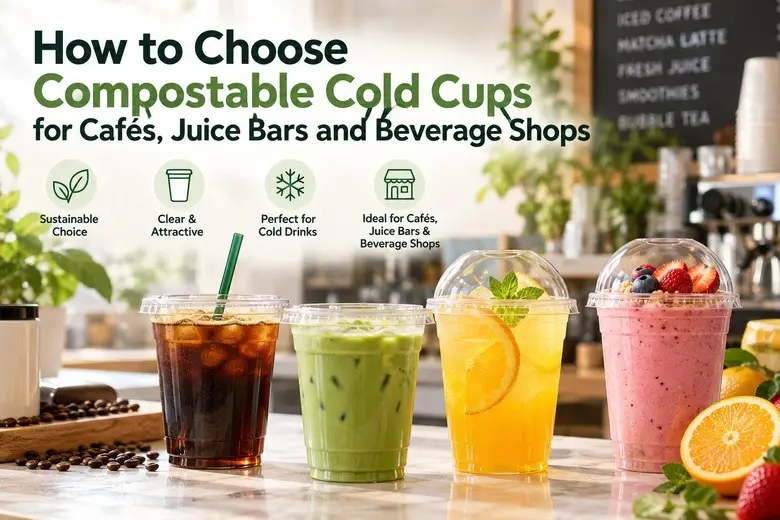
Switching to compostable cold cups sounds simple until the cups reach the counter.
A café may need one cup for iced coffee and another for smoothies. A juice bar wants high clarity because the drink’s color is part of the sale. A bubble tea shop has to think about toppings, wide straws and sealing film. Then there are lids, ice volume, condensation, custom printing and storage.
The word “compostable” does not solve any of those problems.
A cold cup is still working foodservice packaging. It has to fit the drink, the lid, and the way the shop actually operates before its end-of-life story becomes relevant.
For cafés and beverage businesses considering PLA or other compostable cold-drink formats, the best place to start is not the material.
Start with the menu.
Start with the drink you are serving.
An iced Americano and a strawberry smoothie may both leave the counter cold, but they place different demands on the cup.
For iced coffee, buyers usually care about clarity, a secure lid,d and enough space for ice. A sip lid may be useful if the drink is intended to be consumed without a straw.
Smoothies are different. The beverage is thicker, often filled higher, and may include whipped cream or fruit toppings. A dome lid can be more useful than a standard flat lid.
Juice and lemonade put more emphasis on presentation. Color and transparency matter, particularly when the drink itself is visually attractive.
Fruit tea and bubble tea create another set of questions. Is the drink sealed with film? Will it use a flat lid? How large is the straw? Do tapioca pearls or fruit pieces require a wider opening?
The point is straightforward:
Do not select the cup first and then try to make the menu fit it.
Start with the drinks that sell most often and work outward from there.
For businesses with ten or twenty beverages, that does not necessarily mean ten different cups. It usually means identifying a small number of cup-and-lid combinations that cover most of the menu without making operations unnecessarily complicated.
Nominal ounces do not tell the whole story
“16 oz” sounds like a complete cup specification.
It is not.
Two cups sold as 16 oz can differ in height, top diameter, bottom diameter, wall profile, and brimful capacity.
More importantly, the amount printed on a menu is not always the physical volume the packaging needs.
Ice takes space.
So does foam.
So do fruit pieces, cream, and toppings.
If a café sells a 16 oz iced latte, filling exactly 16 oz of liquid into a nominal 16 oz cup may leave no practical headspace for ice or a secure lid.
The quickest way to resolve this is also the least technical:
Make the drink exactly as staff would make it during service.
Use the normal scoop of ice. Add the normal amount of beverage. Add toppings. Put on the intended lid. Then carry it.
A physical menu test is more useful than arguing over catalog capacities.
For many beverage shops, the right cup gives staff enough working room while still delivering the portion the customer expects.
Standardize cup sizes where it makes operational sense
Packaging choice affects more than presentation.
Every additional cup size can mean another sleeve in storage, another carton in the back room, and potentially another lid SKU at the counter.
That matters in a busy shop.
If 12 oz and 16 oz cups can share one lid system, that can simplify inventory. If 16 oz and 20 oz require separate rims, the operational benefit of adding the larger size should justify the extra complexity.
This does not mean forcing every drink into the same cup.
It means looking at the packaging range as a system rather than selecting each size independently.
For a new beverage program, it is worth mapping:
- cup size;
- working fill volume;
- rim diameter;
- lid type;
- straw requirements; and
- menu application.
A simple table can quickly reveal unnecessary duplication.
Lid compatibility deserves its own approval
A cup without the correct lid is not a finished packaging system.
Nominal rim sizes such as 90 mm, 95 mm and 98 mm are helpful, but a matching number on two specification sheets does not always guarantee a secure fit.
Rim geometry matters.
So do material thickness, bead design,n and the way the lid engages with the cup.
A lid can appear to fit when first applied and still become a problem once the drink is carried.
Buyers should test what happens when the cup is:
- filled close to its working volume;
- squeezed lightly by hand;
- placed in a drink carrier;
- transported for delivery; and
- handled after condensation develops.
Different beverages may also need different closures.
A flat lid is often sufficient for juice or standard iced drinks.
A dome lid gives extra space for whipped cream, foam, am or toppings.
A sip lid can suit iced coffee.
Bubble tea may require a wide straw opening or an entirely different sealing system.
Buyers comparing size and lid combinations can review a broader range of PLA compostable cold cups before deciding which formats should be standardized across a beverage program.
The important part is to approve the actual cup and actual lid together.
Do not approve them as separate purchasing decisions.
Be precise about what “compostable” means
This is where material claims require more care.
PLA is widely used in compostable cold-drink packaging, but PLA should not be described simply as a plastic that “disappears naturally.”
Certified compostability refers to defined conditions.
In Europe, EN 13432 sets requirements for packaging recoverable through industrial composting, including biodegradation, disintegration and effects on the composting process and resulting compost. European Bioplastics’ explanation of EN 13432 makes an important distinction: certification relates to controlled industrial composting conditions, not to home composting, soil, waterways or uncontrolled disposal.
The same distinction exists in North America.
The current ASTM D6400-26 specification covers plastics and plastic-containing products intended to compost satisfactorily in municipal or industrial aerobic composting facilities.
For cafés and beverage operators, this leads to two separate questions:
Is the cup supported by appropriate compostability documentation?
and:
Is there a realistic collection and industrial composting route where the cups will be used?
A certified compostable cup can still end up in general waste if customers have nowhere appropriate to put it.
Certification and infrastructure are related, but they are not the same thing.
That should be understood before a café prints a large “COMPOSTABLE” message on the side of every cup.
PLA cold cups are still cold cups
One practical limitation is sometimes buried beneath the sustainability discussion:
PLA cold cups are designed for cold beverage service.
They should not be treated as substitutes for hot-drink cups.
That sounds obvious, but temperature exposure can occur outside the drink itself.
A carton of cups may sit beside a heat source in a café.
Stock may be stored in a hot warehouse.
A delivery vehicle may sit in direct summer sun.
The cup should therefore be stored and used within the conditions recommended by the supplier.
If the same shop sells both iced and hot coffee, it is usually better to use separate packaging systems rather than trying to find one compostable clear cup for both.
Different drinks can justify different materials.
No rule requires a more sustainable packaging program to use the same material everywhere.
Condensation turns the sample into a different cup
An empty sample in a meeting room is usually dry.
An iced drink in July is not.
Condensation affects how the cup feels, how it looks, and how customers handle it.
It can make the surface slippery. It can change label adhesion. It can soften paper accessories around the cup and affect the appearance of printed artwork.
For delivery, condensation can also collect in cup holders or bags.
That is why a cold-cup approval test should include time.
Fill the cup.
Add ice.
Leave it for ten or fifteen minutes.
Pick it up again.
Put it in the carrier the shop uses.
If the business operates in a humid climate, test it in similar conditions.
The cup doesn’t need to stay perfectly dry. Cold beverages naturally create condensation.
The pest checks whether the complete packaging setup still works when that happens.
Transparent cups change the way printing looks.s
Custom artwork on a transparent cup is not the same as artwork printed on white paper.
There is no neutral white background unless the print construction deliberately creates one.
A pale logo may look subtle and premium on a design screen, then almost disappear on an empty clear cup.
Put dark iced coffee behind it and the same logo may look completely different.
Bright juice changes the background again.
This makes the beverage itself part of the visual design.
Before approving a large custom run, brands should look at printed samples with representative drinks inside.
Pay particular attention to:
- light-coloured logos;
- fine text;
- large solid color areas;
- registration between colors;
- print placement on the tapered cup; and
- artwork close to the top or bottom of the printable area.
Judge the design from the customer’s point of view, not just the artwork file.
QR codes need to work on a wet, curved surface.
Cafés increasingly use QR codes for loyalty programs, digital menus, coupons, promotions,s and traceability.
A transparent cold cup is not an easy surface.
It is curved.
The drink behind the code changes contrast.
Condensation may cover the print.
Customers are likely to scan while holding the cup rather than laying it on a flat table.
Basic print rules still matter.
DENSO WAVE, the developer of the QR Code, specifies a clear four-module quiet zone around all sides of the symbol in its QR Code printing guidance.
On beverage cups, however, the final proof should be practical, not theoretical.
Test the code:
- on the actual printed cup;
- with the intended drink inside;
- after condensation develops;
- in typical café lighting;
- from several angles; and
- using more than an ordinary phone.
A QR code that scans perfectly in the PDF artwork isn’t necessarily ready for mass production.
Think about what is already behind the counter
Changing a cup can create unexpected operational changes.
Before switching, check whether the new cup fits:
- existing cup dispensers;
- drink carriers;
- sealing equipment;
- straw sizes;
- lid storage;
- shelf space;
- delivery packaging; and
- carton storage.
A beverage chain with dozens of locations needs to think about this differently from a single independent café.
Changing from one cup system to another may require new lids across every location. That affects training, stock depletion, and warehouse planning.
If the sustainability benefit is worthwhile, that may still be the right decision.
It should simply be planned rather than discovered after rollout.
Ask for documentation that matches the actual cup.
Packaging documents are most useful when they describe the product being purchased.
A buyer considering compostable cold cups should normally ask for enough information to confirm:
Material
What is the cup actually made from?
Compostability
Which standard or certification is relevant, and does it apply to the finished product?
Food contact
Is the product supported by appropriate food-contact documentation for the intended market?
Dimensions
What are the brim diameter, height, and working capacity?
Lid compatibility
Which exact lids have been tested with the cup?
Use conditions
What temperature and storage limitations apply?
Printing
What print method, printable areas, and artwork specifications are available?
A large folder of certificates is not automatically better than a smaller set of documents that clearly match the SKU being ordered.
Compostable cups make sense in the right system.
PLA cold cups can make good sense for cafés, juice bars and beverage businesses where cold service, product visibility and industrial compostability are all part of the packaging strategy.
They are especially logical when a credible route exists to collect and compost them after use.
They may be less convincing where no suitable composting infrastructure exists, where cups are likely to enter another established recovery stream, or where high-temperature exposure is unavoidable.
That does not make PLA good or bad.
It makes material choice application-specific.
The same principle applies to PET, PP, paper and other foodservice packaging materials.
The best material is the one that works with the product, the operation and the waste system available after use.
A practical checklist before changing cold cups
Before placing a bulk order, a café or beverage business should be able to answer these questions:
What drinks will use the cup?
Iced coffee, juice, smoothies, tea, and bubble tea have different requirements.
What is the real working volume?
Include ice, foam,m and toppings.
Which cup sizes are genuinely necessary?
Avoid unnecessary SKUs where possible.
Which lid fits each cup?
Approve the actual combinations physically.
What temperature conditions will the cups experience?
Consider storage as well as service.
How will the cup look with the drink inside?
Check transparency and printing.
How does it perform after condensation develops?
Does any QR code still scan on the finished cup?
What compostability documentation supports the product?
Is industrial composting realistically available after use?
How will the new cups affect existing store operations?
A cup that passes those questions is far more likely to survive the move from a sustainability proposal to everyday service.
The best cup is the one that works at 8:30 on a busy morning
Packaging decisions are easy when the cup is empty.
The real test begins when there is a queue at the counter, ice in the drink, condensation on the wall, a lid that needs to snap on quickly, and a customer carrying three beverages out the door.
That is the environment a compostable cold cup has to work in.
Sustainability still matters. So does certification. So does the end-of-life system.
But cafés should not have to choose between environmental intent and practical packaging performance.
The right cup should do both.
Choose from the drink outward: beverage, working volume, cup, rim, lid printing,g and disposal route.
If those pieces work together, “compostable” becomes more than a word printed on the side of the cup.
It becomes part of a packaging system the shop can actually use.