
“One-stop packaging” sounds straightforward.
In practice, it can mean very different things.
For one supplier, it may mean manufacturing several packaging components under the same roof. For another, it may mean coordinating products from a network of factories. Some suppliers use the term because they can handle packaging design, decoration, sampling and logistics in addition to production.
Others simply have a large catalogue.
For buyers, the label itself is not particularly useful.
The better question is whether the supplier can reduce the amount of coordination required to move a packaging project from specification to production.
That becomes especially important when a project involves several components, more than one material, different decoration processes or multiple SKUs that need to be delivered together.
A genuine one-stop packaging supplier should make complexity easier to manage.
It should not simply move that complexity behind a larger catalogue.
What “one-stop packaging” should actually mean
The most common misunderstanding is that one-stop sourcing means buying everything from one company.
That is only part of it.
The real value is coordination.
A capable supplier should be able to manage several areas at the same time:
- material selection;
- component compatibility;
- sampling;
- printing and decoration;
- dimensional specifications;
- quality control;
- compliance documentation;
- packing;
- lead times; and
- consolidated shipment.
This becomes more important as the number of packaging components increases.
Consider a simple product launch.
The outer bottle may come from one factory. The pump comes from another. Decoration is handled by a third company. The carton is produced somewhere else.
Each supplier may be competent.
The difficulty is making sure all four parts arrive at the right time and work together.
That is where one-stop sourcing can be valuable.
A good supplier does not simply send four quotations.
It takes responsibility for making sure the project behaves like one packaging program.
Example 1: Cosmetic packaging is more than the bottle

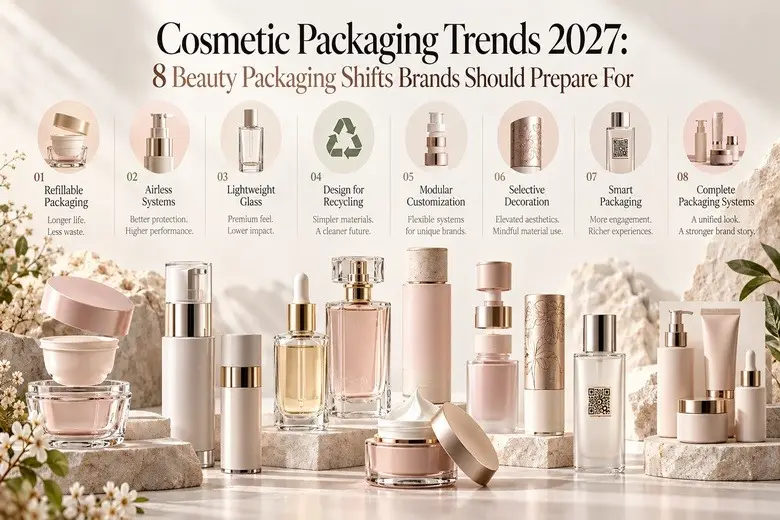
Cosmetic packaging is a good example because a finished pack often looks simple while containing several components.
A serum package may include:
- a glass bottle;
- a dropper;
- a collar;
- a rubber bulb;
- a pipette;
- a wiper;
- decoration; and
- a secondary carton.
A lotion bottle may involve the bottle, pump, dip tube, cap and decoration.
A perfume project can include the bottle, sprayer, collar, cap and crimping requirements.
The bottle itself may not be the part that creates the biggest problem.
A pump can fit the neck and still perform badly with the formula.
A pipette can look correct in a sample and still be too long once the final fill volume is confirmed.
A coating may look perfect after production but scratch during transport.
A cap may match the bottle visually but create an assembly problem on the filling line.
This is why cosmetic packaging buyers should evaluate more than unit price.
A supplier offering a one-stop service should be able to answer questions such as:
Which pump works with this formula?
Is the neck finish standard?
Can the bottle and closure be tested together?
Who is responsible for decoration?
Can the complete assembled package be sampled before mass production?
If the bottle, pump and decoration are coming from different factories, who controls the final specification?
Those questions matter because cosmetic packaging is a system.
A one-stop supplier does not need to manufacture every part itself.
But it does need to understand how the parts affect each other.
That distinction matters.
Example 2: Foodservice packaging often needs several materials
Food packaging presents a different type of sourcing problem.
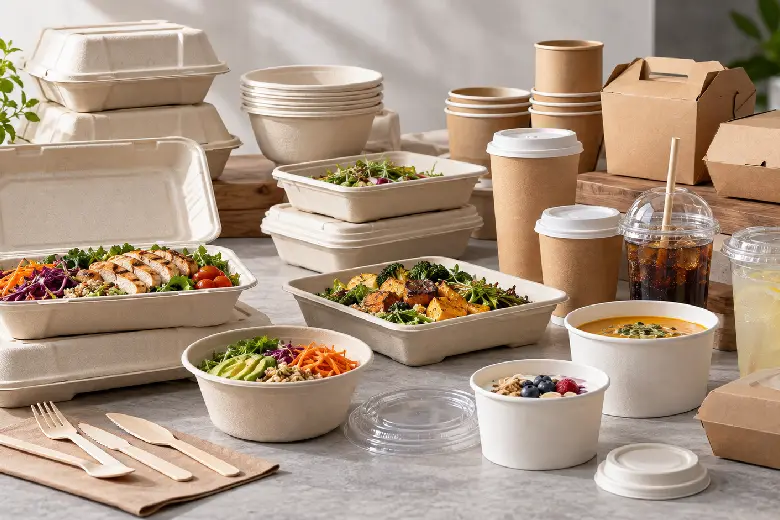
A restaurant group, distributor or foodservice operator may use several packaging formats across the same business.
Hot takeaway meals may use molded fiber.
Soup may require coated paper bowls.
Cold beverages may use PET.
A compostable cold-drink program may use PLA.
Cutlery may be made from CPLA, cornstarch-based materials or conventional plastic depending on the market.
One material rarely covers every application well.
That is why one-stop food packaging sourcing should not mean trying to force an entire menu into one material family.
It should mean selecting different materials for different uses while keeping the purchasing process coordinated.
A typical foodservice program may include:
- molded fiber clamshells;
- bagasse bowls;
- paper cups;
- paper bowls;
- kraft food boxes;
- PET cold cups;
- PLA cups;
- lids;
- forks;
- spoons;
- knives; and
- customized printing.
If every category comes from a different supplier, the buyer is managing several sets of MOQs, artwork approvals, production schedules, quality standards, compliance documents and shipments.
That administrative burden can become significant.
This is where a multi-material supplier can be useful.
One example is Bioleader®, which works across molded fiber, paper bowls & paper food packaging, PLA and PET drinkware, as well as disposable cutlery.
The benefit of this model is not that one material is presented as suitable for everything.
The benefit is that different materials can be matched to different applications while purchasing, documentation and logistics are managed through one supplier relationship.
For foodservice buyers, that can make a practical difference.
A hot-food container may need grease resistance and high-temperature performance.
A cold cup needs clarity, lid compatibility and print quality.
A paper bowl needs a suitable barrier system.
A cutlery set has its own strength and temperature requirements.
These are different technical problems.
A one-stop supplier should be able to explain those differences rather than giving the same environmental claim to every product.
The compliance side matters too.
Food-contact requirements may vary by market.
Compostability documents may apply to some products but not others.
PFAS requirements may be relevant for certain fiber and paper applications.
Buyers should therefore ask whether documentation is managed by product family and whether the certificates or test reports actually apply to the products being ordered.
That is a better test of a supplier than simply asking how many products appear in the catalogue.
Example 3: E-commerce packaging has to work from product box to shipping carton
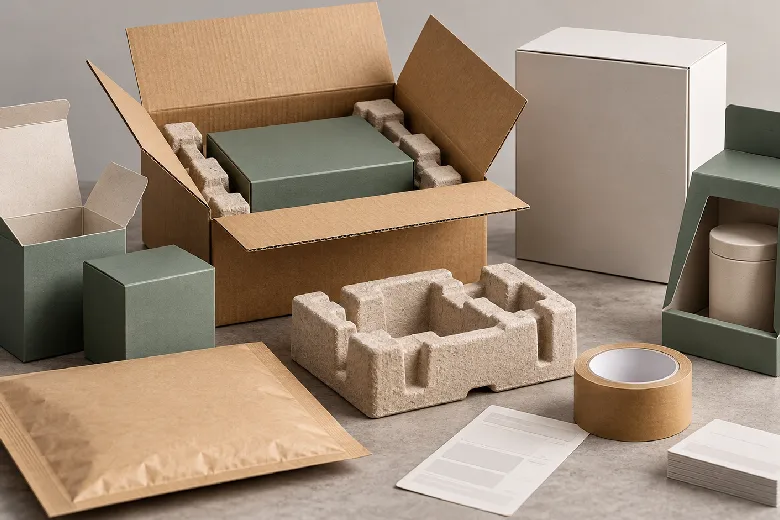
E-commerce and retail packaging create another version of the same problem.
A consumer brand may need:
- a folding carton;
- a protective insert;
- a corrugated shipping box;
- a mailer;
- labels;
- tape; and
- retail display packaging.
Each part can be purchased separately.
But they still have to work together.
A beautifully designed product box may be too large for the most efficient shipping carton.
A protective insert may reduce product damage but increase dimensional weight.
A retail pack may look excellent on shelf and perform badly in parcel delivery.
A shipping carton may be strong enough but use more material than necessary.
When these elements are designed independently, cost can appear in places that were not obvious during quoting.
That is why e-commerce packaging is another area where one-stop sourcing can work well.
The supplier should be able to consider primary, secondary and transport packaging together.
This does not mean every package needs to be redesigned.
Sometimes the biggest savings come from small adjustments:
reducing empty space;
changing an insert;
altering carton dimensions;
using fewer box sizes across several SKUs;
or designing one retail pack that works efficiently inside a standardized shipping carton.
These changes are easier to coordinate when the supplier sees the entire packaging system rather than only one component.
Where one-stop sourcing can actually save money
The assumption that one-stop sourcing is automatically cheaper is not always correct.
A specialist supplier may offer a lower unit price for an individual component.
That does not mean the total packaging program will cost less.
The real savings often come from areas that do not appear clearly on a piece-price comparison.
Fewer suppliers to manage
Every supplier relationship requires communication, purchase orders, specifications, quality checks and payment.
Reducing supplier count can reduce administrative work.
Fewer compatibility problems
A bottle and pump that do not fit correctly can delay a launch.
A cup and lid that were sourced separately can create leakage problems.
A carton that does not match the product dimensions can increase damage or freight cost.
Compatibility mistakes can cost much more than the savings achieved by choosing the lowest-priced component.
Consolidated shipping
Multiple product families can sometimes be packed into the same shipment or container.
This may reduce freight complexity, documentation and local handling.
It can also make lower-volume SKUs easier to manage alongside larger items.
Easier documentation
When products require declarations, test reports or certifications, dealing with fewer suppliers can make document management simpler.
This matters particularly for regulated packaging categories such as food-contact packaging.
Clearer responsibility
When a problem appears, one of the first questions is:
Who owns it?
With fragmented sourcing, one supplier may blame another.
The bottle supplier blames the pump.
The pump supplier blames the filling conditions.
The printer blames the coating.
A one-stop model should create clearer accountability.
That alone can be valuable.
A five-percent saving on one component can disappear quickly if it causes an extra shipment, a failed compatibility test or a delayed launch.
The risk: “one-stop” can also mean “we can source anything”
There is another side to the model.
Some suppliers advertise one-stop service simply because they can buy products from many factories.
That is not necessarily a problem.
Many capable packaging suppliers use partner factories.
The question is how much control they actually have.
Buyers should ask:
Which products do you manufacture directly?
Which products come from partner factories?
Who approves the final specification?
Who carries out quality control?
Who owns the tooling?
Who manages artwork and decoration?
Who issues the compliance documents?
Can a quality complaint be traced to the actual production batch?
These questions reveal whether the supplier is really managing the project or simply acting as a middleman between several factories.
A supplier does not need to manufacture every component under one roof to provide a genuine one-stop service.
But it does need to control specifications, quality and accountability across the supply chain.
Without that control, one-stop sourcing can become another layer of communication rather than a reduction in complexity.
Technical depth matters more than catalogue size
One of the easiest ways to evaluate a supplier is to listen to the questions it asks.
A weak supplier usually moves quickly toward price.
A stronger supplier asks about the application.
For cosmetic packaging:
What is the formula?
What is the viscosity?
Which pump output is needed?
How will the bottle be decorated?
For food packaging:
What food will go inside?
What temperature?
How long does it need to hold oil or sauce?
Which lid is required?
What is the target market?
For e-commerce:
What is the product weight?
What are the shipping conditions?
How fragile is the item?
What damage rate is currently acceptable?
These questions show whether the supplier understands packaging as an application rather than a commodity.
That matters because the wrong packaging can still be cheap.
It is simply cheap before the problem appears.
Buyers should also look at sampling
Sampling is one of the clearest indicators of how well a supplier manages multiple components.
If the project includes a bottle, pump and cap, can the supplier provide the assembled set?
If a foodservice program includes a bowl and lid, can they be tested together?
If a shipping project includes an insert and carton, can the complete packed configuration be evaluated?
Sampling should reproduce the final use condition as closely as practical.
A loose bottle sample does not prove pump compatibility.
An empty takeaway container does not prove oil resistance.
A printed carton without the product inside does not prove transport performance.
One-stop sourcing has the most value when sampling also becomes integrated.
Customization should be coordinated, not fragmented
Customization is another area where supplier coordination matters.
Many packaging projects involve several processes:
colour matching;
screen printing;
offset printing;
hot stamping;
coating;
embossing;
labelling;
or mould development.
If each process is controlled separately, errors become harder to trace.
A strong one-stop supplier should be able to provide a clear approval sequence.
For example:
first approve the packaging specification;
then confirm the decoration method;
then approve artwork;
then produce the physical sample;
then approve the assembled pack;
then release mass production.
This sounds basic.
But many packaging problems begin when those steps happen in the wrong order.
Artwork gets approved before the final bottle is confirmed.
A lid is selected after the container has already entered production.
Decoration is approved on a flat file without testing the actual surface.
Coordination is one of the main reasons buyers choose one-stop sourcing in the first place.
A buyer checklist for choosing a one-stop packaging supplier
A useful evaluation does not need to be complicated.
The following questions cover most of the important areas.
- Does the supplier actually cover the product categories needed for the project?
A large catalogue is not useful if the key components still need to come from somewhere else.
- Does the supplier understand the technical differences between materials?
A supplier should be able to explain why one material works better than another for a specific application.
- Can components be tested together?
Compatibility should be demonstrated where possible.
- Can the supplier provide complete samples?
Assembled samples are often more useful than individual components.
- Are compliance documents tied to the actual product?
Certificates and test reports should be relevant to the SKU being purchased.
- Is customization managed through one approval process?
Printing, decoration and tooling should not become separate projects unless necessary.
- Are MOQs transparent by product family?
“One-stop” does not mean every product will have the same MOQ.
- Is quality control centralized?
The buyer should know who is responsible for final inspection.
- Can different products be consolidated for shipment?
If not, some of the logistical value of one-stop sourcing disappears.
- Who takes responsibility when something goes wrong?
This may be the most important question.
One-stop sourcing works when complexity disappears for the buyer
The best one-stop packaging supplier is not necessarily the company with the longest product catalogue.
It is the supplier that can make different materials, components, specifications and delivery schedules behave like one packaging program.
In cosmetics, that may mean coordinating a bottle, pump, closure and decoration.
In foodservice, it may mean managing molded fiber, paper, PLA, PET and cutlery across one menu.
In e-commerce, it may mean making the product box, protective insert and shipping carton work together.
The industries are different.
The sourcing principle is the same.
The value of one-stop packaging is not that one supplier can sell more products.
It is that the buyer has fewer interfaces to manage, fewer compatibility problems to solve and clearer responsibility when decisions need to be made.
One-stop sourcing works when complexity disappears for the buyer—not when it is simply moved behind a larger catalogue.