Clear cold drink cups look like one of the simpler items on a foodservice packaging list.
Then the samples arrive.
One 16 oz cup is taller than another. Two lids both say 98 mm, but only one snaps on properly. A logo that looked sharp in the artwork becomes difficult to read once dark iced coffee is behind it. The QR code scans perfectly on an empty cup and becomes unreliable when the surface is covered with condensation.
None of these problems is unusual.
For cafés, juice bars, bubble tea chains and foodservice distributors, choosing a cold cup is less about finding “a clear plastic cup” and more about getting several small decisions to work together: material, usable capacity, rim geometry, lid style, drink conditions and printing.
The cup and lid should be treated as a packaging system, not as two separate catalog items.
Start with the drink, not the cup material
Buyers often begin with material:
PET, PLA or PP?
It is usually better to begin with the menu.
An iced Americano, a fruit smoothie and a bubble tea may all be sold cold, but they create different packaging demands.
A drink with large ice cubes needs enough working volume above the liquid. A smoothie may need a dome lid. Bubble tea may require a wide straw or sealing film. Fruit tea can contain citrus pieces or toppings that affect the opening and lid choice. An iced latte may look much better in a highly transparent cup than in a more translucent material.
Service conditions matter as well.
Will the drink be prepared and consumed immediately?
Will it sit on a delivery shelf for 20 minutes?
Will cups be stored pre-stacked beside the counter?
Will they be transported in four-cup carriers?
Will the customer handle the cup outdoors in humid weather?
These details often influence the final choice more than the material name printed on a specification sheet.
PET, PLA, and PP may look similar, but they do different jobs
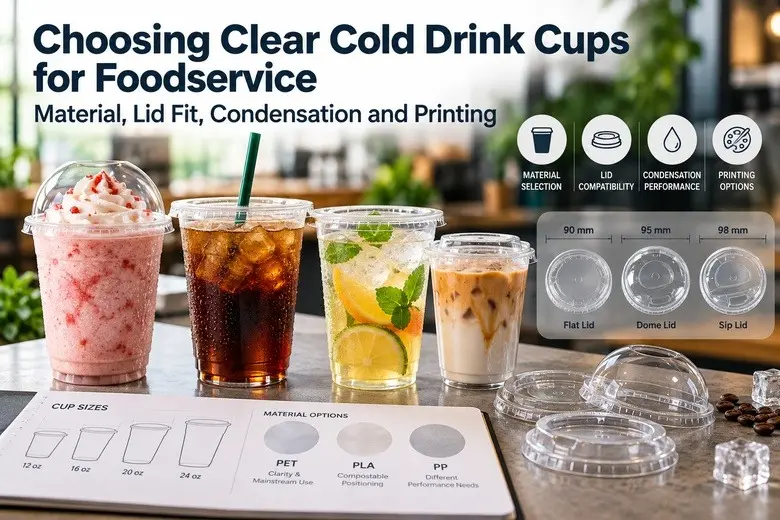
Three clear or semi-clear plastics appear frequently in foodservice beverage packaging: PET, PLA and PP.
They should not be treated as interchangeable.
PET
PET is widely used for clear cold cups because appearance is one of its strengths. Iced coffee, juices, smoothies, fruit teas and layered drinks remain highly visible through the cup.
For buyers building a conventional cold-drink program, clear PET cups for foodservice are available across a broad range of capacities and rim systems, including different flat, sip, and dome lid combinations.
PET is primarily a cold-service material in this type of application. A buyer should not assume that a clear PET cold cup designed for iced drinks can simply be moved into a hot-drink program.
PLA
PLA can provide a similarly clear appearance, which is one reason it is considered for cold beverage applications where compostability is part of the packaging strategy.
But “PLA” and “compostable” should not be used as loose synonyms.
The relevant question is whether the finished product is certified for a defined composting route. European Bioplastics notes that products certified to standards such as EN 13432 are intended for industrial composting under controlled conditions. That is different from claiming that a cup will readily break down in any natural environment.
For buyers considering PLA, the disposal system therefore belongs in the sourcing discussion from the beginning, not after the cup has already been chosen.
PP
PP is another common foodservice plastic, but its appearance and performance profile differ from clear PET.
It is often selected where buyers have different temperature or flexibility requirements, although the actual operating limits still depend on the finished cup design and material grade.
The practical point is simple:
Choose the material around the application rather than trying to make one material serve every drink.
A chain may even have good reasons to use different materials for different parts of its menu.
“16 oz” is not enough information to buy a cup
Capacity labels create another source of confusion.
A buyer asks for a 16 oz cup and assumes the specification is nearly finished.
It is not.
Two cups carrying the same nominal ounce designation can differ in:
- actual capacity;
- brimful capacity;
- recommended working volume;
- top diameter;
- bottom diameter;
- height;
- wall profile; and
- headspace.
That becomes noticeable once ice, foam, fruit pieces, or toppings are added.
For example, a menu may call the finished drink “16 oz,” but the packaging team may need more than 16 oz of physical cup volume to accommodate ice and leave enough headspace for a secure lid.
This is particularly important for drinks assembled by staff rather than filled automatically. A cup that is technically large enough can still be operationally awkward if employees have to fill it almost to the rim.
Before approving a cup, test the actual recipe.
Put in the normal amount of ice. Add the drink. Add foam or toppings. Close the intended lid.
That simple test often reveals more than another hour spent comparing catalog capacities.
Lid fit is not just a diameter
Rim diameter is important, but it is only the beginning.
Cold-cup ranges commonly include families such as 90 mm, 95 mm and 98 mm. These numbers are useful because they narrow the search for a matching lid.
They do not guarantee compatibility.
A 98 mm lid should not automatically be assumed to fit every cup described as 98 mm.
Small differences in rim geometry, bead shape, material thickness, and lid construction can determine whether the lid snaps into place correctly and stays there.
This matters most after the drink leaves the counter.
A lid can appear acceptable during a quick hand test and still loosen when:
- the cup is squeezed;
- condensation makes the surface slippery;
- the drink is carried in a delivery bag;
- cups move inside a carrier; or
- the beverage is filled close to the top.
The closure also needs to suit the drink.
Flat lids
Flat lids work well where the contents remain below the rim, and additional headspace is unnecessary.
Dome lids
Dome lids create extra space for whipped cream, smoothie toppings, fruit, or dessert presentation.
Sip lids
Sip-style openings may suit iced coffee and other drinks consumed without a straw, depending on the cup system.
Straw openings and sealing film
Bubble tea and similar drinks can require an entirely different approach. Straw dimensions, topping size, and the intended sealing method all need to be considered.
This is why professional cup sourcing should approve the cup and lid combination, not merely approve a cup SKU and then search for a lid later.
Condensation changes the cup after it leaves the counter
Cold drinks create water on the outside of a cup. Everyone knows that.
It is still regularly underestimated during packaging approval.
A dry sample on a conference table is not the same product experience as an iced drink after ten minutes in warm, humid air.
Condensation affects more than appearance.
It can change grip, label adhesion, sleeve behavior,r and the way printed graphics look. It can also make a cup harder to handle during delivery.
Dark beverages introduce another visual variable. Printing viewed against an empty transparent cup can look completely different once the background becomes iced coffee, cola, or dark fruit tea.
That is why artwork approval on a computer screen is not enough for a heavily branded clear cup.
A more realistic sample test is printing it, filling it, chilling it, and then looking at it again.
Printing on a clear cup is not the same as printing on white paper
Artwork often reaches a cup supplier as a file originally designed on a white screen.
The finished cup has no white background unless one is intentionally created.
That changes color perception.
A light logo placed directly on clear plastic may virtually disappear when the cup is empty. Put a dark beverage behind it and the same design may suddenly become visible—but with a very different appearance from the original artwork.
Fine text can also lose definition on a curved surface.
Large blocks of color may expose registration or ink-coverage issues more clearly than a small logo.
And because the cup narrows toward the bottom, artwork that looks rectangular in a flat design file may need adjustment when transferred onto the tapered cup body.
These are production issues, not branding theory.
The safest approval process is to review the artwork on the actual cup profile rather than treating the PDF proof as the final visual result.
QR codes deserve their own test.
More beverage brands are printing QR codes on cups for loyalty programs, menus, promotions, traceability,y and campaign pages.
A cup is a surprisingly demanding surface for a QR code.
It is curved.
It may be transparent.
The beverage behind the code can change contrast.
The cup may be wet.
Customers may scan it while holding the drink rather than placing it on a flat surface.
Even the basic geometry matters. DENSO WAVE, the company behind the QR Code, specifies that the code requires a clear “quiet zone” around the symbol and notes that module size affects readability. Its technical guidance recommends considering both printer capability and the device that will read the code.
GS1 makes a similar point for printed barcode quality: contrast, quiet zones, symbol size, print quality, ty and positioning all affect scanning performance, with cylindrical packaging specifically identified as a positioning consideration.
This becomes particularly relevant on cups.
A QR code that scans from the designer’s monitor is not an approved cup.
Neither is one that scans from a dry, empty production sample.
For printed beverage packaging, a better approach is to test the QR code:
- on the actual cup;
- after printing;
- with the intended beverage inside;
- under normal lighting;
- with condensation present;
- from several realistic scanning angles; and
- with more than one ordinary phone.
A detailed guide to printing and testing QR codes on plastic cups makes the same distinction between checking the digital artwork and verifying the finished, filled cup.
The final test should reproduce how a customer will actually encounter the code.
Good cup programs usually use fewer lid systems, not more
For chains and distributors, there is another issue that rarely appears in product photography: inventory.
Suppose a beverage program has four cup sizes.
If every size uses a different lid, that means four lid SKUs must be ordered, stored, replenished, and matched correctly at store level.
If two or three cup sizes can share a properly engineered rim family, operations may become simpler.
That can mean:
- fewer lid cartons;
- less storage space;
- easier staff training;
- fewer picking mistakes;
- simpler forecasting; and
- greater flexibility if one cup size runs short.
This does not mean buyers should force every drink into one rim diameter.
The menu still comes first.
But lid rationalization is worth considering when a new cup range is being designed from scratch.
Packaging cost is not only the unit price printed on a quotation. Complexity has a cost as well.
Custom printing should be approved with the production cup
Custom printing introduces another reason to settle the cup specification before artwork approval.
Changing from one 16 oz cup profile to another can alter:
- printable area;
- artwork curvature;
- logo position;
- distance from the rim;
- visual proportions; and
- QR code location.
If a brand approves artwork before the exact cup has been locked, the artwork may need to be adjusted later.
For a first production run, buyers should ideally approve:
the exact cup + the exact lid + the actual print construction.
Where possible, the sample should then be filled with a representative drink.
For a multinational beverage program, it is also worth recording approved artwork versions carefully. A surprisingly common sourcing problem is not poor printing, but the wrong revision of the artwork being sent into production.
The carton matters too.
Cold cups are light, which makes buyers focus heavily on the piece price.
But international buyers are not shipping individual cups. They are shipping cartons and containers.
Cup geometry affects nesting. Nesting affects carton dimensions. Carton dimensions affect cubic volume.
A slightly different cup profile can therefore change the logistics cost even when the cup weight and unit price look similar.
This becomes more noticeable with high-volume foodservice programs.
Procurement teams comparing two cup suppliers should look beyond:
price per 1,000 cups.
They should also compare:
- pieces per sleeve;
- sleeves per carton;
- carton dimensions;
- gross weight;
- cubic volume;
- lid packing; and
- container-loading efficiency.
The cheapest cup at factory level is not always the lowest-cost cup after transport and handling.
What should be approved before bulk production?
The final approval file does not need to be complicated.
It does need to be specific.
For most custom cold-cup programs, it should answer the following:
Which material?
PET, PLA, P, P, or another specified material.
Which exact cup?
Capacity alone is not enough. Record the dimensions or supplier SKU.
Which rim and lid?
Approve the actual combination rather than just the nominal diameter.
Which drink application?
Include intended temperature and representative contents.
Which artwork revision?
Record the final approved file and printing position.
Has the printed sample been viewed with the drink inside?
Especially important for transparent cups.
Does any QR or barcode still work after filling and condensation?
Test the finished package.
What is the packing configuration?
Confirm sleeves cartonso, cartons, and export packing before the purchase order is closed.
A sample that passes these checks gives the buyer something much more useful than a generic statement that the cups are “high quality.”
It creates a repeatable production specification.
A cold cup is a small packaging system.
The most reliable cold-drink programs are rarely built by choosing the most attractive cup first and solving everything else afterward.
They begin with the drink and work outward.
The beverage determines the working volume.
The working volume helps determine the cup.
The cup determines the rim family.
The rim influences the available lids.
The drink color and condensation influence the printing.
The service model determines whether the entire combination works outside the test room.
That is why a clear cup should not be bought as an isolated piece of plastic.
For foodservice procurement, the better question is not:
“Which cup do we want?”
It is:
“Which cup, lid, and print system will still work when the drink is actually in it?”
That is the specification worth approving.