For the past decade, businesses have been evolving towards having sustainable packaging for their products. Companies have tried a wide range of material options that claim to be compostable and include visual signals of environmental responsibility.
By trying various materials, they realized that not every material known to be sustainable is actually sustainable in practice.
I have conducted thorough research and listed the most sustainable packaging materials that not only claim to be compostable or recyclable but also actually work.
But before discussing sustainable packaging trends for 2026, let’s first understand what sustainable packaging is.
What is Sustainable Packaging?
Sustainable packaging refers to packaging solutions that help reduce environmental impact, minimize waste, and use renewable or recycled materials. Sustainable packaging materials are used to manufacture wrapping paper, custom boxes, and containers for various products and brands that claim to be eco-friendly.
Key Features of Sustainable Packaging:
Sustainable packaging comes with its own unique characteristics and key features, and some of them are as mentioned below:
- Recyclable
- Compostable & Biodegradable
- Reusable
- Minimilastics
Now that you know enough about sustainable packaging, let’s discuss its trends in 2026.
2026 Sustainable Packaging Trends
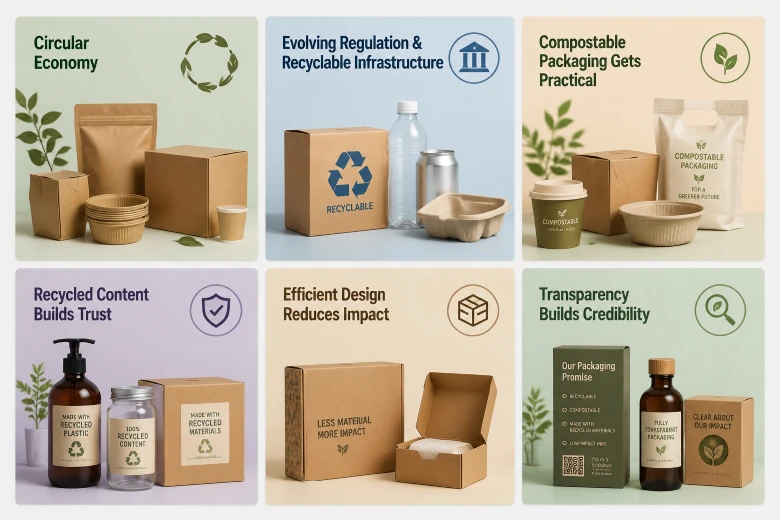
The trend toward sustainable packaging has changed significantly over the past decade. However, the most popular sustainable packaging trends for 2026 are as follows:
1. Circular Economy
One of the most popular trends for sustainable packaging is the circular economy.
So what is the circular economy in sustainable packaging?
A circular economy for sustainable packaging is a system in which packaging is designed to be reused, recycled, or composted rather than discarded. It reduces waste, conserves resources, and keeps materials in continuous use for longer.
This approach is becoming more important because simply replacing plastic with another material does not always solve the waste problem.
Businesses are now thinking about what happens to packaging after customers use it.
For example, packaging designed around a circular economy may:
- Use materials that can easily be recycled.
- Contain recycled materials.
- Be designed for repeated use.
- Use fewer mixed materials.
- Be easier for customers to separate and dispose of.
The main goal is to keep packaging materials in use instead of constantly producing new ones.
2. Evolving Regulations and Recycling Infrastructure
Packaging regulations are also becoming an important part of sustainable packaging in 2026.
Governments and regulatory bodies are putting more attention on packaging waste, recycling, labeling, and producer responsibility.
As a result, businesses can no longer focus only on how sustainable their packaging looks.
They also need to consider whether their packaging can actually enter the recycling system available in the markets where they sell their products.
This is important because recyclable packaging does not always mean it will actually be recycled.
The local recycling infrastructure must also be capable of collecting, sorting, and processing that particular material.
Brands are therefore paying more attention to:
- Material selection
- Recycling compatibility
- Waste management requirements
- Packaging labels
- Local recycling systems
- Producer responsibility requirements
This trend may encourage businesses to choose simpler packaging materials that are easier to recycle.
3. Compostable Packaging Gets More Practical
Compostable packaging is not a new idea.
However, businesses are becoming more careful about where and how they use it.
In the past, many brands used compostable materials mainly because they sounded environmentally friendly.
The problem is that some compostable packaging requires specific industrial composting conditions. Customers may not have access to those facilities.
In 2026, compostable packaging is becoming more practical.
Businesses are considering whether the packaging will actually reach a composting facility instead of simply ending up in normal waste.
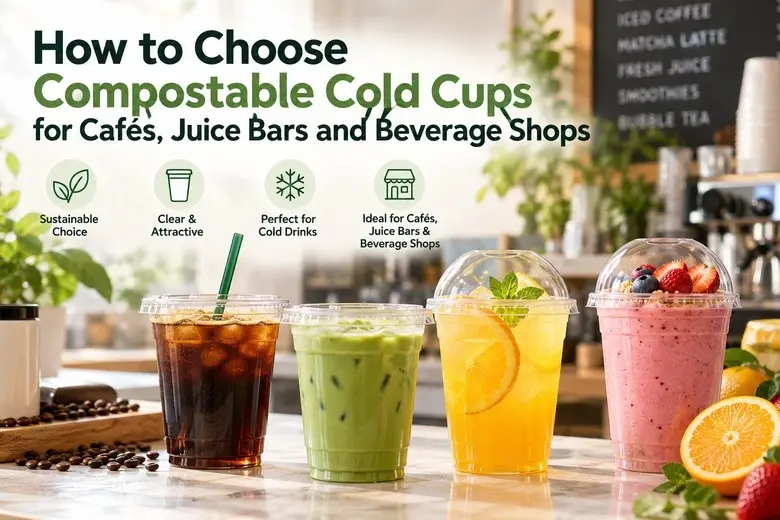
Compostable packaging can be useful for products such as:
- Food packaging
- Takeaway containers
- Disposable cups
- Food trays
- Pouches
- Certain wrapping materials
The important factor is choosing compostable packaging for applications where it makes practical sense.
Brands should also clearly explain how customers should dispose of the packaging.
4. Recycled Content Builds Customer Trust
Using recycled materials is another major sustainable packaging trend for 2026.
Instead of producing packaging entirely from virgin materials, brands are increasingly looking for packaging containing recycled content.
Recycled paper, cardboard, plastic, and other recovered materials can be turned into new packaging products.
This helps reduce the demand for new raw materials.
For example, recycled paper fibers can be used to manufacture boxes, paper bags, protective packaging, and other paper-based solutions.
Using recycled content also gives businesses a clear way to communicate their sustainability efforts.
However, brands need to be careful about the claims they make.
Simply printing words such as “recycled” or “eco-friendly” on packaging is not enough.
Customers increasingly expect businesses to provide clear information about how much recycled content their packaging contains.
Specific and understandable information can build more trust than broad environmental claims.
5. Efficient Packaging Design Reduces Environmental Impact
Another sustainable packaging trend gaining attention is efficient packaging design.
Sustainable packaging is not only about choosing a different material.
The amount of material used also matters.
A box made from recyclable material can still create unnecessary waste if it is much larger than the product inside.
That is why brands are focusing on right-sized and minimalist packaging.
Efficient packaging design can help reduce:
- Excess material
- Empty space inside boxes
- Protective filler requirements
- Packaging weight
- Storage requirements
- Transportation space
Using smaller and properly sized packaging can also allow more products to fit inside shipping vehicles.
This can improve packaging efficiency and reduce unnecessary transportation requirements.
Brands are also simplifying packaging structures.
For example, replacing several different packaging components with one properly designed structure can reduce material usage and make disposal easier for customers.
6. Transparency Builds Credibility
Customers are becoming more aware of environmental claims made by brands.
That is why transparency is becoming one of the most important sustainable packaging trends for 2026.
Instead of simply writing “green,” “natural,” or “eco-friendly” on packaging, businesses are expected to explain what actually makes their packaging sustainable.
Brands can provide information about:
- Material composition
- Recycled content
- Recycling instructions
- Composting requirements
- Packaging certifications
- Disposal methods
- Material sourcing
Simple recycling symbols and disposal instructions can also help customers understand what they should do with the packaging after use.
Some businesses are also using QR codes to provide additional information without filling the packaging design with too much text.
Transparency helps customers make informed decisions.
More importantly, it helps businesses avoid sustainability claims that cannot be properly supported.
What Materials Are Trending in Sustainable Packaging?
Along with changes in packaging design and recycling practices, certain materials continue to play an important role in sustainable packaging.
Some commonly used options include:
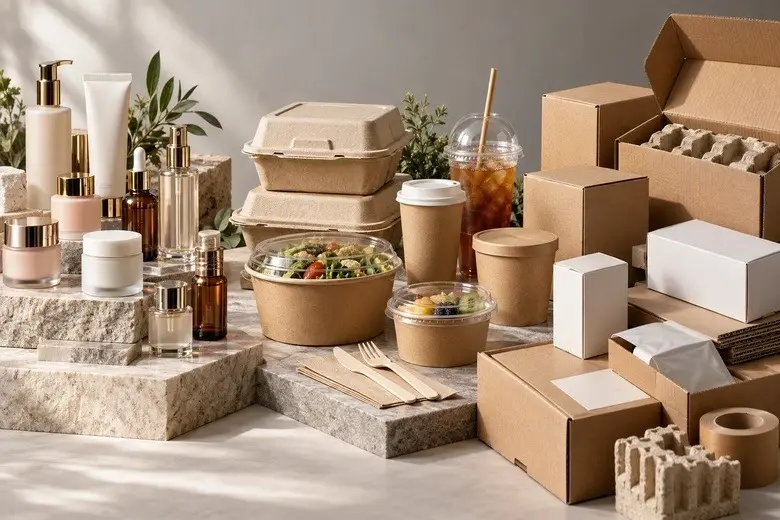
Recycled Paper and Cardboard
Paper and cardboard remain widely used for sustainable packaging because they can be recycled through established recycling systems in many areas.
They are commonly used for:
- Folding cartons
- Corrugated boxes
- Paper bags
- Sleeves
- Inserts
- Shipping boxes
Using recycled fibers can further reduce the need for virgin raw materials.
Kraft Paper
Kraft paper is commonly used for bags, boxes, wrapping, and protective packaging.
Its simple appearance also allows brands to reduce excessive printing and decorative layers when they want a more minimal packaging design.
Molded Fiber
Molded fiber packaging is commonly produced using recycled paper fibers.
It can be shaped around a product and used for trays, inserts, containers, and protective packaging.
It is particularly useful when brands want an alternative to some plastic packaging inserts.
Corrugated Cardboard
Corrugated cardboard is commonly used for shipping and protective packaging.
Its fluted structure provides protection while keeping the packaging relatively lightweight.
It can also contain recycled fibers and can be recycled again where suitable recycling facilities are available.
Compostable Materials
Compostable materials can be useful in selected packaging applications, particularly food-related products.
However, businesses need to consider whether the required composting facilities are available before choosing them.
A compostable claim alone does not automatically make packaging environmentally responsible.
Is Sustainable Packaging Always Better?
Not necessarily.
A packaging material should not be considered sustainable only because it is made from paper, plants, or recycled content.
Its complete lifecycle needs to be considered.
Businesses should look at factors such as:
- Where the material comes from.
- How much material is required.
- How the packaging is manufactured.
- How far it needs to travel.
- Whether it protects the product properly.
- Whether customers can reuse or recycle it.
- What happens to it after disposal.
Product protection is especially important.
If reducing packaging causes products to become damaged during transportation, more products may need to be replaced. This can create additional material, transportation, and product waste.
Therefore, sustainable packaging should balance environmental responsibility with practical performance.
How Can Businesses Make Packaging More Sustainable in 2026?
Businesses do not always need to completely replace their packaging to make progress.
Small changes can also reduce packaging waste.
Brands can start by reviewing their existing packaging and identifying unnecessary materials.
They can then:
- Reduce oversized packaging.
- Remove unnecessary packaging layers.
- Increase recycled content where practical.
- Choose materials compatible with recycling systems.
- Improve recycling and disposal instructions.
- Reduce mixed-material packaging.
- Design packaging that customers can reuse.
- Ask packaging manufacturers about lower-waste alternatives.
The most effective solution will depend on the product, supply chain, customer, and available waste management infrastructure.
Conclusion
Sustainable packaging trends for 2026 are becoming more practical and less focused on environmental appearance alone.
Circular packaging systems, recycled content, efficient designs, practical compostability, better recycling infrastructure, and transparent environmental claims are becoming more important.
For businesses, the goal should not simply be to choose packaging labeled as sustainable. They should consider how the packaging is produced, used, recycled, reused, or disposed of in real-world conditions.
Choosing packaging that works throughout its lifecycle can help businesses reduce unnecessary waste while still protecting their products properly.