
What is Secondary Packaging?
Secondary packaging is the packaging layer placed around one or more primary packages. It does not usually come into direct contact with the product. Instead, it holds individual products together, protects them from physical damage, and makes them easier to store, transport, display, and manage.
Common examples of secondary packaging include folding cartons, corrugated boxes, display boxes, sleeves, trays, shrink wrap, and multipack carriers. The right packaging type depends on the product’s dimensions, weight, sensitivity, shipping method, and retail requirements.
For a full understanding, read our latest secondary packaging guide.
Now that you know what secondary packaging is, let’s discuss the types of secondary packaging.
Secondary Packaging Types
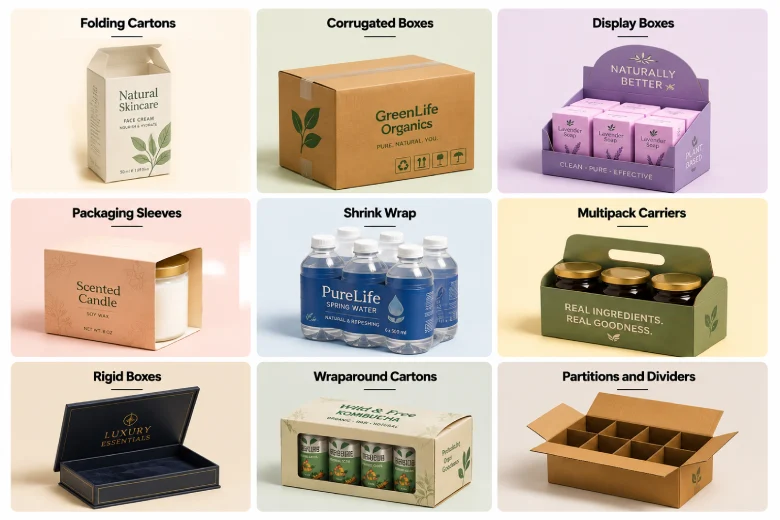
Below are some of the most common types of secondary packaging used across different industries.
Folding Cartons
Folding cartons are lightweight paperboard boxes commonly used to package products that are already placed inside bottles, jars, tubes, blister packs, or pouches. They are widely used in the cosmetics, food, pharmaceutical, electronics, and personal care industries.
These cartons can be customized with logos, colors, product information, instructions, ingredients, and promotional graphics. They are easy to fold, assemble, store, and transport. Folding cartons also provide extra protection against dust, scratches, and minor impact.
Corrugated Boxes
Corrugated boxes are made from multiple layers of paperboard, including a fluted inner layer placed between flat outer sheets. This structure makes them strong, lightweight, and suitable for storing and transporting products.
They are commonly used for e-commerce orders, electronics, food products, household goods, clothing, and industrial items. Corrugated boxes protect primary packaging from pressure, vibration, impact, and movement during shipping.
Brands can select single-wall, double-wall, or triple-wall corrugated boxes depending on the weight and fragility of the product. They can also include inserts, dividers, or cushioning materials for added protection.
Display Boxes
Display boxes are designed to protect products while presenting them attractively in retail stores. They are often placed on shelves, countertops, checkout areas, and promotional stands.
These boxes usually have an open front or removable section that allows customers to see and access the products easily. They are commonly used for snacks, cosmetics, small electronics, medicines, toys, and personal care products.
Display boxes can be printed with branding, product details, and promotional messages. Their design helps improve product visibility and encourages customers to make purchasing decisions.
Packaging Sleeves
Packaging sleeves are paperboard or cardboard covers that slide over a product, tray, box, or container. They provide additional protection and branding without completely enclosing the product.
Sleeves are often used for food trays, soap boxes, cosmetics, candles, gift items, books, and electronic accessories. They offer a modern and minimal appearance while providing enough space for logos, instructions, barcodes, and product information.
Packaging sleeves are lightweight and require less material than full boxes. They can also be designed with windows or cutouts to display the product inside.
Shrink Wrap
Shrink wrap is a flexible plastic film used to group several products together. Heat is applied to the film, causing it to shrink tightly around the packages.
It is commonly used for bottled water, soft drinks, canned food, cosmetics, cleaning products, and promotional multipacks. Shrink wrap keeps products together and protects them from dust, moisture, dirt, and tampering.
This packaging type is lightweight and allows customers or warehouse workers to see the products inside. However, brands should consider recyclable or reduced-plastic alternatives when working toward sustainability goals.
Multipack Carriers
Multipack carriers are designed to hold several individual products together as one unit. They are often used for beverage bottles, cans, yogurt cups, food containers, and household products.
These carriers may be made from paperboard, corrugated cardboard, molded fiber, or plastic. They often include handles that make the package easier to carry.
Multipack carriers help brands sell products in larger quantities and create promotional bundles. Their printable surface can also be used for branding, product information, and marketing messages.
Rigid Boxes
Rigid boxes are strong, durable boxes made from thick paperboard. Unlike folding cartons, they do not collapse or fold flat. They are commonly used for luxury products, jewelry, watches, cosmetics, electronics, perfumes, and premium gifts.
Rigid boxes provide excellent protection and create a high-quality unboxing experience. They can include magnetic closures, ribbons, foam inserts, molded trays, or fabric linings.
Although rigid boxes are usually more expensive than standard cartons, they can improve the perceived value of a product and strengthen the brand’s premium image.
Wraparound Cartons
Wraparound cartons are paperboard packages folded around primary containers such as bottles, cans, jars, and food cups. They hold multiple products together while leaving parts of the containers visible.
These cartons are often used for beverages, dairy products, canned goods, and promotional bundles. They provide structure and make products easier to carry, stack, and display.
Wraparound cartons use less material than fully enclosed boxes and provide a large printable area for branding, product details, and promotional offers.
Partitions and Dividers
Partitions and dividers are placed inside boxes or cartons to separate individual products. They help prevent bottles, jars, cans, and fragile items from touching or colliding during transportation.
They can be made from corrugated cardboard, paperboard, molded pulp, foam, or plastic. Dividers are commonly used for glass bottles, cosmetics, electronic components, medicines, and delicate products.
These packaging components improve product organization and reduce the risk of scratches, cracks, breakage, and other forms of damage.
Conclusion
Secondary packaging is available in many forms, including folding cartons, corrugated boxes, display boxes, sleeves, trays, shrink wrap, multipack carriers, rigid boxes, wraparound cartons, and dividers. Each type provides different benefits related to product protection, transportation, organization, retail presentation, and branding.
The right choice depends on the product’s size, weight, fragility, shipping conditions, storage needs, and customer expectations. By selecting suitable secondary packaging, brands can reduce product damage, improve distribution efficiency, strengthen their visual identity, and create a better shopping experience.