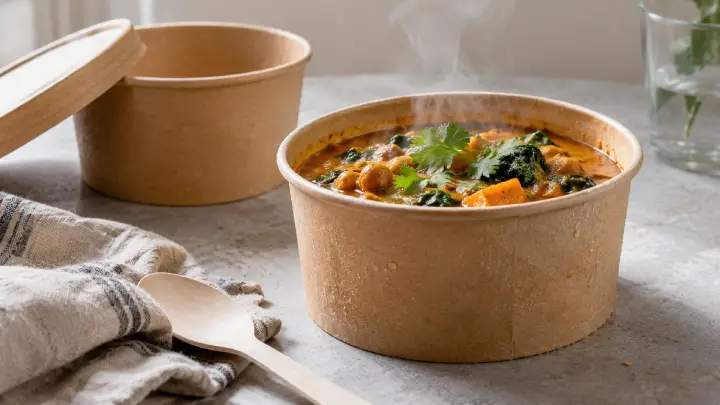
One phrase I hear surprisingly often in food packaging is: “It is made of paper, so why does it need a barrier?”
The answer usually becomes obvious as soon as food is added.
A dry paper bowl sitting on a desk can look perfectly strong. Fill the same bowl with hot soup, chili oil, or curry, close the lid, and leave it in a delivery bag for 40 minutes, and the package is dealing with something very different.
This is why I am cautious when a food container is described simply as “paper” or “fiber packaging”.
Fiber provides the structure. It does not, by itself, tell us whether the package will survive the job.
For hot and prepared foods, much of that job is done by the barrier system.
The food usually tells us more than the material name
When a buyer asks us whether a paper bowl is suitable for hot food, my first question is normally not about the bowl.
It is about the food.
Is it clear soup? Curry? Fried chicken? Pasta with an oily sauce? How hot is it when packed? Is it eaten immediately or delivered after an hour?
These details matter because water and oil do not attack fiber in exactly the same way, and neither does steam.
A bowl that works well for a light broth during a short lunch service may not be the right bowl for a high-fat curry traveling across a city on a motorcycle.
That sounds obvious, but packaging is still frequently specified using very broad requirements such as “waterproof”, “oil-proof” or “suitable for hot food”.
Those words are not useless. They are simply incomplete.
For practical food packaging, I prefer to think in terms of four variables:
food composition, temperature, contact time, and movement.
Change one of them and the result can change.
We saw this clearly in our own paper-bowl testing.
Earlier in 2026, our team ran a practical comparison on several paper and kraft bowl structures.
Instead of testing them only with room-temperature water, we prepared a mixture containing boiling water, cooking oil,l and soy sauce. The liquid was around 100°C when the test began.
It is not a standardized laboratory method, and I would never present it as one. We used it because it creates a fairly unpleasant environment for a food container: heat, water, salt,lt and oil at the same time.
The results were more useful than a simple pass/fail statement.
A 12 oz kraft bowl with a water-based barrier became slightly softer around the edges under the hot exposure, but it still retained its shape and did not leak. Several PE-coated structures stayed noticeably more rigid.
All of them might reasonably be described as hot-food paper bowls.
But they did not behave in exactly the same way.
That is the point.
Knowing the base paper is not enough. Even knowing the coating chemistry is not always enough. Coat weight, coverage, paper porosity, forming quality,ity and the finished geometry all influence what happens once the package is used.
In real failures, I often pay particular attention to the places that look least interesting: the bottom seam, a folded corner, the rim, or a cut edge.
The middle of the sidewall may still look perfect while moisture has already started finding another route.
A barrier is a system, not a label.
There is a tendency in sustainable packaging discussions to compare coatings as though one chemistry must always be better than another.
PE versus PLA. Aqueous versus extrusion coating. Coated versus uncoated fiber.
That comparison has value, but it can become too simplistic.
A barrier that performs well on one paperboard can perform differently on another. A coating that looks excellent on a flat sheet still has to survive creasing, cup forming, heat sealing,g and transport.
For molded fiber, the same principle applies in a different way.
Fiber density, forming pressure, surface treatment,nt and grease resistance have to work together. Simply adding more barrier material is not necessarily the best engineering solution.
In manufacturing, consistency matters just as much as the headline material.
A perfect sample is not very useful if the 50,000th container behaves differently.
The most useful tests are often uncomfortable ones
Standardized laboratory tests are important. They give us repeatable ways to compare water absorption, grease resistance, and other properties.
But I do not think they should be the end of the discussion.
If the customer is selling curry, I want to see what happens with curry.
If the container is going into a delivery bag for 45 minutes, a five-minute static test tells us very little about the real risk.
We published another internal demonstration using a PFAS-free molded-fiber container. The container held rice, oily leftovers,s and roughly 200 ml of water.
We microwaved it on high power for three minutes, left it standing for 30 minutes, then reheated it for another two minutes.
After the second heating cycle, the fiber structure had become somewhat softer. That was visible.
But there was still no leakage from the bottom or edges, and the container remained functional.
I actually think the softening is an important part of that result.
Packaging testing should not be designed to produce a beautiful marketing photograph. It should tell us where the limits begin to appear.
“No change whatsoever” is not the only acceptable result. The real question is whether the package continues to perform safely and adequately throughout the intended use period.
Holding time is probably underestimated.d
Buyers usually ask about temperature first:
“Can it hold 100°C soup?”
That is a reasonable question, but I would add another immediately:
“For how long?”
A container filled at 95°C and consumed ten minutes later has a much easier job than one that is sealed, stacked, and delivered for an hour.
Food packaging failure is often progressive.
The paper begins to absorb moisture. An edge softens. Steam changes the rim slightly. Oil starts to show through a weak point. The lid fit changes because the bowl has lost some stiffness.
Nothing dramatic happens in the first minute.
That is why, for delivery packaging, I find 15-, 30-, and 60-minute observations much more informative than an immediate inspection after filling.
There is no universal correct holding time. The test should follow the business model.
“Recyclable paper” needs the same level of caution
The barrier question does not end when the customer finishes the meal.
It also affects what happens to the package afterward.
A paper package can contain a large amount of valuable fiber and still be difficult to recycle in a particular system. Coatings, adhesives, wet-strength additives,s and food residue can all influence how easily the fiber is recovered.
But there is an even bigger issue: infrastructure.
We sometimes talk about recyclability as if it were an inherent characteristic of an object.
In reality, a package has to pass through several steps.
Someone has to collect it. A sorting system has to put it into the correct stream. A recycler or paper mill has to accept and process it. The recovered material needs somewhere useful to go.
This is why I make a distinction between technically recyclable and recycled in practice.
A structure may be perfectly capable of being repulped in the right mill and still end up being discarded in a market where foodservice paper packaging is not collected.
Changing the coating does not automatically solve that infrastructure problem.
The same reasoning applies to compostable packaging. A material may meet the relevant compostability requirements, but if there is no collection route or suitable composting facility, the technical property alone does not determine the actual end of life.
Start with the meal, then design the package
For me, this is the simplest way to avoid bad packaging decisions.
Do not begin with:
“We need a paper bowl.”
Begin with:
“We need to pack an oily noodle dish at about 90°C, close it immediately, stack two containers, and deliver them for up to 45 minutes.”
Now we have something useful to engineer.
From there we can decide the required barrier, paper or fiber structure, lid, sealing method and test conditions.
We can also ask the end-of-life question properly: where will this package be sold, what collection system exists there, and what disposal claim can actually be supported?
This approach is less convenient than choosing packaging from a catalog based on a material name.
But it produces fewer surprises.
There is no perfect barrier.
I do not believe the packaging industry needs the strongest possible barrier on every fiber package.
It needs the right barrier.
Too little protection can lead to leakage, softening, food waste,e and unhappy customers.
Too much material or an unnecessarily complex structure can increase cost and make the end-of-life route more difficult.
The interesting work is in between.
The aim should be to use enough barrier performance to get the food safely through its real service life, while keeping the package as simple and recoverable as the application allows.
That is why “paper”, “fiber”, “plastic-free”, “recyclable” and “compostable” are useful descriptions, but none of them is a complete packaging specification.
A food package has to work before we can decide what to call it.
And to know whether it will work, we need to look at the whole system: the fiber, the barrier, the converting process, the food, the temperature, the time, and, finally, what happens to the package after use.