
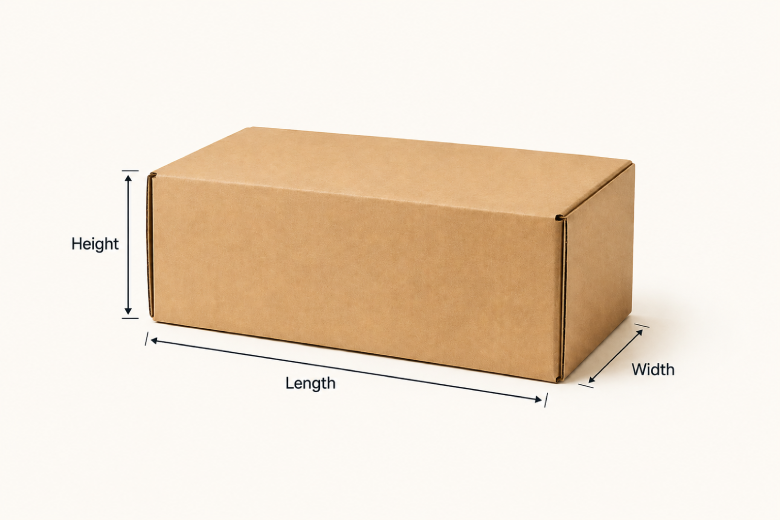
If your box is too small, your product may not fit properly. If it is too large, your product can move around during handling. Extra space may also increase your packaging and shipping costs.
In this article, we will discuss packaging dimensions, how to measure length, width, and height, and what you should check before choosing a box.
What Are Packaging Dimensions?
Packaging dimensions are the measurements that describe the size of a package. For rectangular boxes, these measurements are usually written as length × width × height, also known as L × W × H.
Each measurement describes a different direction. Together, they help you understand the box size and whether it can hold your product.
Understanding what packaging is also helps explain why these measurements matter. Packaging needs to protect your product, support handling, and make storage easier. Choosing the right dimensions helps it perform these tasks.
Understanding Length, Width, and Height
For a typical rectangular box, start by identifying its intended opening. Keep the box in this position while measuring all three dimensions.
| Dimension | What It Measures | Example |
| Length (L) | The longer side of the box opening | 10 inches |
| Width (W) | The shorter side of the box opening | 6 inches |
| Height (H) | The distance from the base to the top | 4 inches |
The example above would be written as 10 × 6 × 4 inches (L × W × H).
Length is not always the longest measurement of the entire box. A tall box can have a height greater than its length. For custom packaging, follow the manufacturer’s drawing to confirm which measurement belongs to each side.
You may also see height described as depth. Check the supplier’s labels before placing an order, as these terms can vary between packaging styles.
Internal vs. External Packaging Dimensions
Before measuring a box, decide whether you need its internal or external dimensions. These measurements serve different purposes.
Internal Dimensions
Internal dimensions describe the space inside the assembled box. They help you check whether your product, inserts, and protective materials will fit.
For example, a box with internal dimensions of 10 × 6 × 4 inches offers that amount of space before adding inserts or padding. A product with exactly the same measurements may be difficult to pack or remove. You need suitable clearance for the intended fit.
External Dimensions
External dimensions describe the size of the assembled box from the outside. They include the packaging walls and help you plan shelf space, storage, and shipping.
Two boxes with the same internal dimensions can have different external dimensions. Their material thickness, folded layers, and box construction can affect the outside size.
Always confirm which dimensions a supplier lists. Do not assume every box size refers to the same type of measurement.
How to Measure Your Packaging Dimensions
You can use a ruler or measuring tape to check a box. Keep your measurements straight and use the same unit throughout.
Start With Your Product
Place your product in the position it will sit inside the box. Measure its length, width, and height at the widest points. Include any parts that stick out, such as handles, caps, or pumps.
For multiple products, arrange them as they will be packed. Measure the complete arrangement, including the space needed for dividers.
Allow Space for Protection
Account for any tissue paper, wrapping, cushioning, or custom inserts. These materials take up space and can change the box size you need.
There is no single amount of extra space that works for every product. A glass jar and a folded shirt have different protection needs. Choose the allowance based on your product and confirm it with a sample.
Measure the Assembled Box
Assemble the box in its intended shape. For internal measurements, measure between the inside surfaces along each direction. Measure the usable height from the inside base to where the closed lid will sit.
For external measurements, close the box and measure between its outermost points. Do not include upright open flaps as part of the finished box height.
Write Down the Complete Size
Record the measurements in the supplier’s required order. Include the unit and state whether the dimensions are internal or external.
For example, write 250 × 150 × 100 mm, internal dimensions, L × W × H.
This gives your manufacturer more useful information than writing three numbers without labels. Keep accurate measurements for production and follow separate carrier rules when entering shipping dimensions.
A Simple Packaging Dimensions Example
Suppose your product measures 8 × 4 × 2 inches. For this example, assume the packaging design needs half an inch of cushioning on every side.
The cushioning adds one inch to each overall measurement:
- Length: 8 + 0.5 + 0.5 = 9 inches.
- Width: 4 + 0.5 + 0.5 = 5 inches.
- Height: 2 + 0.5 + 0.5 = 3 inches.
The product and cushioning would therefore occupy 9 × 5 × 3 inches. This is a starting point for choosing the internal box size. Packing clearance and the box construction may require further adjustments.
The cushioning amount here is only an example. Test the actual product and protective materials before approving your packaging dimensions.
How Packaging Materials Affect Box Dimensions
Your material choice affects the relationship between internal and external dimensions. Thin paperboard and thicker corrugated board do not take up the same amount of space.
Folded panels, rigid box walls, and fitted inserts can also reduce the usable space inside a package. This is why changing the material may require another size check, even when the product stays the same.
Our complete packaging materials guide explains the main material options and their uses. Review the material and box structure together before finalizing your measurements.
How Packaging Dimensions Affect Shipping Costs
Shipping costs can depend on both package weight and size. Dimensional weight is a calculation that accounts for the space a package occupies. A large, lightweight box may therefore cost more to ship than its actual weight suggests. UPS explains how dimensional weight works.
For shipping, measure the outside of the fully packed, closed package. UPS identifies the longest side as length, which can differ from the labels on a manufacturer’s box drawing. Follow your carrier’s current measurement and rounding rules when entering shipment details.
Choose a box that allows enough protection without unnecessary empty space. Check the finished package before comparing shipping options.
Common Packaging Measurement Mistakes to Avoid
Small measurement mistakes can cause fitting problems and production delays. Before confirming your packaging size, check for these issues:
- Mixing internal and external dimensions: State clearly which measurements you are providing.
- Changing the measurement order: Label length, width, and height to prevent confusion.
- Ignoring protective materials: Include the space needed for inserts, wrapping, and dividers.
- Leaving out units: Specify inches, centimeters, or millimeters with every size.
- Confusing flat and assembled sizes: A flat dieline includes panels, flaps, and tabs. Its overall size is different from the finished box dimensions.
- Skipping a physical sample: Check the fit, closure, and product removal before production.
Also ask your manufacturer about production tolerances. These are the agreed limits for small size variations during manufacturing. They are separate from the extra space needed around your product.
Final Takeaways
Accurate packaging dimensions start with your product and its protection needs. Measure carefully, label length, width, and height, and confirm whether the sizes are internal or external. Check your material thickness and test a sample before production.
For more practical guides on packaging design, materials, and product protection, explore Packaging Editorial.
Frequently Asked Questions
What Order Do Packaging Dimensions Go In?
Rectangular box dimensions are commonly written as length × width × height. Always confirm the supplier’s format and include the measurement unit, especially when ordering custom packaging.
Can Length and Width Be the Same?
Yes. A box with a square opening has equal length and width. Its height can be different. For example, a box may measure 8 × 8 × 3 inches.
Are Product Dimensions the Same as Packaging Dimensions?
No. Product dimensions describe the item itself. Packaging dimensions describe its container. The box also needs space for protective materials, inserts, and enough clearance to pack and remove the product.
How Do You Calculate the Volume of a Box?
Multiply length by width by height. A rectangular space measuring 10 × 6 × 4 inches has a volume of 240 cubic inches. Volume alone does not confirm product fit.
Should You Measure a Box When It Is Open or Closed?
Check internal dimensions with the box assembled and accessible. Measure height to the intended closed position. For shipping, measure the external dimensions after packing and closing the box.
Do All Packaging Types Use Length, Width, and Height?
No. Tubes may use diameter and height, while pouches may use width, height, and gusset size. Follow the supplier’s measurement guide for the packaging style you need.